How to make money with print on demand

Bursting with creative design ideas but lacking the initial funds to make money from them? Print on demand could be the perfect low-risk solution. Here's a guide on how.

If you’ve got the creativity and looking to earn some extra cash, print on demand offers a simple way to start an online business without needing a big budget.
With minimum investment or previous experience needed, print on demand could be the perfect side hustle you need to help you through your time at uni. And the flexibility means you can fit working on your store around your studies.
But don't be fooled into thinking it's easy money. You'll need to put the time and effort in to get the sales.
This guide will walk you through everything you need to know. From choosing a niche and creating designs to setting up your store, finding suppliers and marketing your products.
What's in this guide?
- What is print on demand?
- How to start a print on demand business
- Best print on demand companies
- Pros and cons of print on demand
What is print on demand?
Print on demand is an e-commerce business model where products are only printed and shipped once a customer has placed an order.
This makes it a great low-risk option for starting a business, as no initial investment is needed. You don't need to worry about paying out for the stock and then not being able to sell it, as it will only be printed once it's been ordered.
Print on demand can be as easy as uploading your design to a platform and listing the products. Most print on demand companies have hundreds of different products to choose from, but popular print on demand products include t-shirts, hoodies and mugs.
If a customer orders your product, the print on demand suppliers will deal with the printing, packaging and delivery for you. Simple!
However, making your print on demand business successful isn't always that simple. Unless you strike gold and some celebrity miraculously spots your design, orders it, and it gets seen by the masses, you're going to have to put the legwork in.
Competition is super high, and you'll need to market and perfect your products before you see the orders rolling in.
How to start a print on demand business

Here are the steps you need to take to start a successful print on demand business:
-
Choose a niche
Possibly the most important step of them all. As we've mentioned, some people might get lucky, but generally, you're going to need a strong niche and unique design to help you stand out from the crowd.
Where once you might have been able to bang a funny quote on a t-shirt and get sales, the marketplace is flooded with these now, and you'll have to be pretty damn funny to get seen.
Think about hobbies you may be able to profit from, professions or interests that people are passionate about (and preferably that you are too). This is a good start, but you'll need to filter it down to a smaller audience. For example, rather than 'pet lovers', you'll need to be more specific and focus on perhaps 'cocker spaniel lovers'.
You can research niches on social media to see how active and passionate their communities are.
-
Create a design
Now it's time to let your creativity flow!
Whether it's a logo, image, pattern or piece of artwork, it's important to always keep your audience in mind. Put yourself in their shoes and think what designs they might like - big, bold and colourful or subtle and refined?
You don't need to be a designer to create print on demand products; there is design software to help you on your way. Canva, for example, is super easy to use and has hundreds of templates. You'll also find that some print on demand sites have their own design tools.
These days, you can even use AI to create designs for you. Just make sure any images it creates are permitted for commercial use. And remember the importance of creating something unique. AI can generate hundreds of designs for you, but generic images won't make you stand out from the crowd.
If you really aren't up to the task of creating a design, you can also find freelancers on sites like Fiverr to do the design work for you.
Just keep in mind what products you think you might want your designs on. Which takes us to our next point...
Be aware that if you're thinking of using AI-generated images in your design, you can't copyright them, meaning anyone could copy them. -
Choose your products
 There's a huge range of print on demand products to choose from for your design. Some companies offer over 500,000! But some of the most popular products include:
- Clothing such as hoodies, t-shirts and socks
- Homeware such as mugs, coasters and throws
- Accessories such as tote bags and phone cases
- Wall art such as posters and canvas prints.
Again, the most important thing is to keep your audience in mind and personalise your products.
It may sound obvious, but it's also important to think about the seasons. You're not going to sell many hats and scarves in the height of summer.
-
Research print on demand companies
Next step – find the right print on demand suppliers for you.
You need to be checking product pricing, shipping costs and times, customer service and where the company is based. Read some reviews, and if you've already decided on products, you can start by finding which companies have these.
If you think your audience will be mainly UK-based, it makes sense to use a company based in the UK, as they'll be working in the same time zone and shipping costs should be cheaper.
To help you out, we've listed a few of the best print on demand suppliers below.
You'll also need to check which platforms and marketplaces the company can integrate with, which brings us on to our next point.
-
Decide how you want to sell
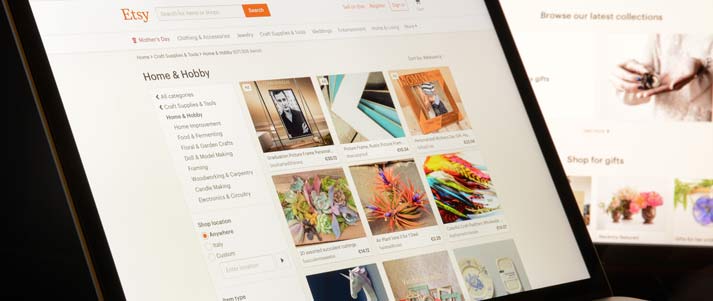
Credit: Jarretera – Shutterstock
Next decision is how and where you want to sell your new designs.
You've basically got two options. You can either sell them on an already existing marketplace, such as Etsy or Amazon. Or, you can use an e-commerce platform such as Shopify, Wix or Squarespace and set up your own website to sell from.
There are pros and cons to both of these.
When selling from a marketplace such as Etsy, you could benefit from the fact that it already has customers visiting the site. However, there is also loads of competition, so you'll need to be certain you're offering something unique.
If you build your own website to sell your print on demand products, you'll have complete control of your products and payment processing, but you'll need to invest more time to get the traffic to your site and make the sales.
Either way, you'll find the print on demand companies we've listed below will integrate with all major e-commerce platforms and marketplaces.
Shopify is a great place to start if you're looking for an e-commerce platform that is super easy to use. We have a full guide on how to create a Shopify store, -
Market your products
This is where you'll have to put the extra legwork in if you want to make money with print on demand. It's no use shoving your products online and leaving them there to get lost amongst the others. You'll need to promote them.
Social media is super useful when it comes to tapping into communities. Find groups on Facebook, TikTok or Instagram specific to your audience and promote your products there. You may want to look into paid ads to reach these specific audiences.
Customers like to know what's going on behind the scenes, not just the outcome, so you can use social media to promote your story and the ethos behind your business (if you have one!) The more of a following you can build, the easier your sales will be.
Though you may not have been lucky enough to find a celebrity wearing your product, you could contact influencers within your niche market and see if you can partner up.
Check out our guide on how to make money from social media for more ideas.
-
Keep your listings updated
To stay on top of the game, make sure you keep an eye on which of your products are selling and which aren't. If something really isn't selling, then take it down.
Refreshing and editing your listings helps you keep up to date with current trends. Listen to the feedback customers give you and try tweaking designs or features to see what sells.
Best print on demand companies
As we've already mentioned, you really need to research the different companies offering print on demand services to find one that fits your needs.
To make things a bit simpler, we've put together a table comparing the price of getting a basic t-shirt printed and shipped within the UK from different print on demand sites.
Just remember it's not only the price which you need to take into account. You'll also need to check where they're based, the quality of their products, and what their customer support reviews are like.
Print on demand price comparison |
||||||
| Print on demand site | T-shirt cost | UK shipping cost | Total cost | Best deal | ||
|---|---|---|---|---|---|---|

Printify |
£6.95+ | £2.64+ | £9.59+ |
Full review |
||

Printful |
£6.75+ | £3.59+ | £10.34+ |
Full review |
||

Inkthereadable |
£6.74+ | £2.88+ | £9.62+ |
Full review |
||

Gelato |
£6.75+ | £3.19+ | £9.94+ |
Full review |
||

Prodigi |
£9+ | £2.25+ | £11.25+ |
Full review |
||
|
USD prices have been converted into GBP and were correct at the time of update. | ||||||
All prices are exclusive of VAT and based on the cost of a basic cotton T-shirt shipped within the UK.
Here’s a more detailed breakdown of our five best print on demand sites:
Printify
- Pricing – Free or $39/month (approx £29) for Premium plan
- Product range – 1300+ products
- Shipping speed – 2–7 days fulfilment, plus 3–5 days* (UK) depending on the print provider
- Shipping costs – from approx $3.49 (approx £2.60) single item, $1.99 (approx £1.50) additional items, check exact shipping costs on the site.
Printify boasts one of the largest product ranges for print on demand, and according to the website, is trusted by more than 10 million merchants.
It’s free to sign up and get started with your online business, with access to all the product designs. But when the sales start flooding in, you may want to look into their Premium subscription, which offers discounts on products, custom branding and up to 10 stores.
It has a global network of print providers, making worldwide delivery easy without crazy shipping costs. These costs are dependent on the print provider, but you can check out the exact shipping costs on the website.
Printful
- Pricing – Free or £19.99/month for Printful Growth
- Product range – 502 products
- Shipping speed – 2–5 days fulfilment, plus 2–4 days* (UK) delivery, check global shipping times on the site
- Shipping costs – £3.59 single item, £1.20 additional items.
The main difference between companies like Printify and Printful is that Printful uses its own in-house facilities for product supply, rather than outsourcing orders to different print suppliers around the world.
Though this means shipping costs and times can be higher in some circumstances, it also means the quality is more consistent. And with a fulfilment centre in the UK, delivery times here are still quick.
Printify also has a paid plan which offers discounted products, branding and sample orders and unlimited stores.
Inkthereadable
- Pricing – Free, plus 10% discount with Reward pricing if you spend over £500 per month
- Product range – 250+ products
- Shipping speed – 3–5 days fulfilment, plus 1–5 days* (UK) delivery, check global shipping times on the site
- Shipping costs – from £2.88 single item; check international shipping costs on the website.
Inkthereadable is a UK-based, family-run business. So if you’re after more of a personal touch, they may be the best option for you. They even have offices in Lancashire where they’re happy for customers to pop in for a brew!
All printing is done in the UK, meaning the turnaround for UK orders is quick. It has a strong eco-focus, with a great range of eco-friendly apparel, vegan-friendly printing and plastic-free packaging.
Gelato
- Pricing – Free or $29.99/month (approx £22.50) or $120/yr (approx £90) for Gelato+
- Product range – 250+ products
- Shipping speed – 3–5 business days fulfilment and shipping (UK) delivery, check global shipping times and rates on their site
- Shipping costs – from £2.80 (single item), check international shipping costs on the website.
Gelato has a similar model to Printify in that any orders placed are printed and fulfilled through its global network of partners in 32 countries.
Local fulfilment can be a great plus as it cuts down on shipping times and costs, and of course, carbon emissions. However, if you’re working with a variety of different production companies, you may find that the quality and consistency of the products vary.
Gelato+, the paid plan, offers discounted products, unlimited stores and access to design tools and stock images.
Prodigi
- Pricing – Free or £40/month or £420/year for Prodigi Pro
- Product range – 500,000+ products
- Shipping speed – 1–4 day fulfilment plus 1–3 business days shipping (UK)
- Shipping costs – from £2.25 (single item), £1 for additional items.
Although Prodigi has a huge portfolio of over 500,000 products, it’s most renowned for its selection of framed artworks, canvas prints and posters.
Many reviews say that the colour and quality of Prodigi’s printing is superior to other POD companies, making it a great option if you’re looking to sell your artwork.
You can get a 50% discount on your first sample order with the free account, so there’s really no reason not to give it a try.
Prodigi’s paid plan also offers discounted products and 75% savings on custom packaging inserts, such as stickers or flyers.
Is print on demand worth it?
If you’re still struggling to decide whether print on demand is the right business for you, here’s a list of the pros and cons of starting a print on demand business:
Pros of print on demand
- Low start-up costs – with no stock to buy, and free design tools available, you can set up an online store for free
- No stock management – no worries about where to store your stock, as products are only made once an order has been placed, and the product is shipped straight to the customer
- Easy to set up – print on demand sites are simple to use and easily integrate with e-commerce platforms and marketplaces
- Flexibility – you can be flexible with your work time and locations, working remotely from anywhere, and as we’ve already mentioned, fitting your work around your studies.
Cons of print on demand
- Lower profit margins – because your products are only getting produced once an order is placed rather than in bulk, the cost of production is higher, making your profit margins less
- Competition – there’s a lot of competition in the print on demand market, so you’ll need to put some hard work in to get your product seen
- No quality control – as your product is going straight from the printing company to the customer, you have little control over the quality of the product, which can affect your reputation.
If setting up your own print on demand business isn’t quite what you had in mind, we’ve got many more small business ideas that might be right for you.