National Student Accommodation Survey 2026 – Results

Big changes are afoot in the rental market. But as this year's National Student Accommodation Survey reveals, many of the challenges that student tenants face may remain unsolved.
Credit: Monkey Business Images – Shutterstock (background)
This year's National Student Accommodation Survey is a landmark 10th edition, coinciding with the eve of some of the biggest rental reforms in a generation.
On 1st May 2026, the Renters' Rights Act will come into effect in England. This promises sweeping changes, including greater protections for tenants.
However, one of the key reforms brought in by the Act – the extension of the Decent Homes Standard to the private rented sector – won't be fully implemented until 2035.
Critics of the Renters' Rights Act also fear that its measures could lead to an exodus of landlords and a decline in the number of rental properties. This would only intensify the housing crisis that has plagued students in recent years.
These changes – or lack thereof – all come at a time when students continue to face unprecedented financial hardship. As consecutive National Student Money Surveys have shown, significant real-terms cuts to the Maintenance Loan in England have left many struggling to afford even the most basic of necessities.
So while the impact of the Renters' Rights Act remains to be seen, it's clear that the government must take urgent action to increase Maintenance Loans to catch up with inflation. That, coupled with clear progress in increasing the student housing supply, will go a long way to alleviating the struggles faced by those at university.
What's in this report?
Key findings
These are some of the headlines from the National Student Accommodation Survey 2026:
- The average cost of rent among those surveyed was £575 per month. London was the most expensive region (£793 per month).
- Although rent has risen more slowly than inflation and the Maintenance Loan, the proportion struggling with the cost has risen to 61%.
- The student housing shortage has forced 35% to rent a property without viewing it.
- 8% of respondents said they've experienced homelessness as a student.
- 36% have thought about dropping out of university due to the cost of rent.
- The average amount that parents contribute towards student rent has dropped to £205 per month.
- 65% have had at least one issue with their student home, with damp (30%) the most common.
- Over two in five (41%) feel their accommodation represented poor value for money.
- 15% believe they will never own a house.
Expert comment
Save the Student's money expert, Tom Allingham, said:
We're just weeks away from the Renters' Rights Act finally coming into effect, but we're deeply concerned that it will do little to address the biggest problems students face with their accommodation.
With the recent focus on Student Loan repayments, this is the perfect opportunity to discuss the plight of current students. And, as our survey has uncovered, the university housing shortage is forcing them to make unenviable decisions.
Students are having to queue outside estate agents – sometimes overnight – just to secure viewings. As many as 8% of respondents said they'd experienced homelessness as a student. And, due to the level of competition for housing, over a third said they'd agreed to rent a property without even viewing it.
The Renters' Rights Act will tackle some of the impacts of the housing shortage – notably, a ban on rental property bidding wars, and a cap on the amount of rent a landlord can demand up front. But treating the symptoms can only do so much – we need to address the cause.
So, in addition to a long-overdue increase in student maintenance funding to catch up with inflation, we're calling on the government to tackle the university housing crisis as a matter of urgency.

Where do students live during term time?
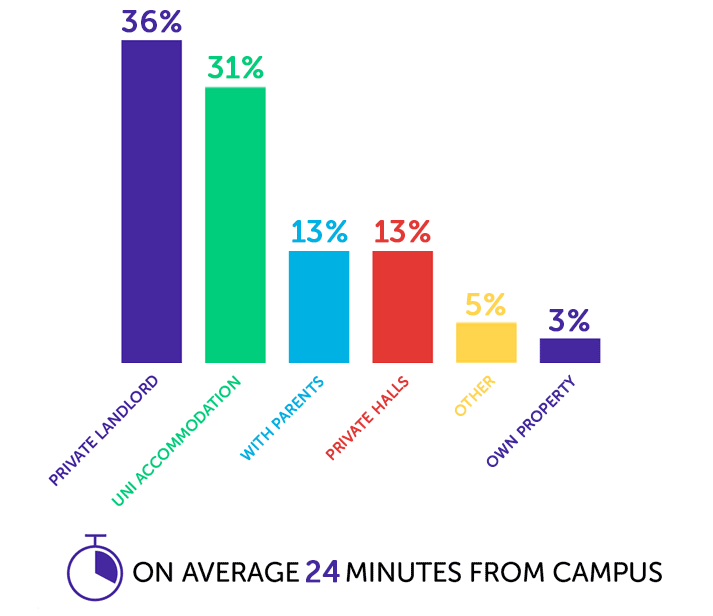
There was a minimal year-on-year change in the proportion of respondents who said they live in each accommodation type, with all landing within one or two percentage points of the equivalent answers in 2025's survey.
The most popular arrangement was renting from a private landlord, as it has been in every edition of our National Student Accommodation Survey. Given that university halls are usually reserved for first-year students, and the relative expense of private halls, it's no surprise that so many rent privately.
On average, respondents said they live 24 minutes away from their university. This is slightly down on 2025's figure (26 minutes), but the long-term data still reflects the well-documented rise in commuter students; in 2022, the average distance was just 21 minutes.
When do students look for accommodation?
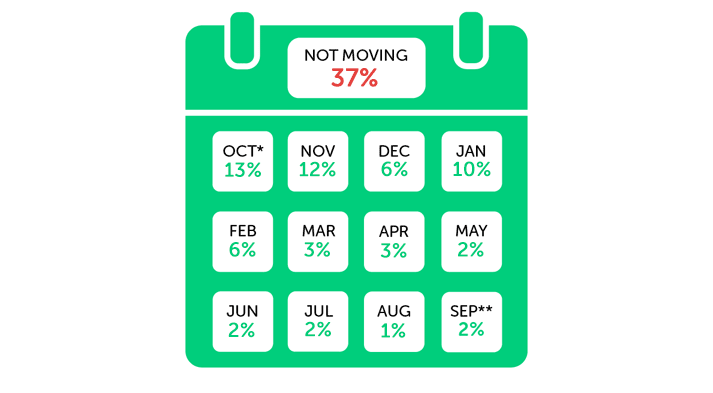
*This includes anyone who answered 'Before November'
**This includes anyone who answered 'After August'.
A quarter of students in our survey said they started their search for next year's accommodation in November or earlier. At the other end of the scale, 37% said they weren't planning to move at all next year, continuing the upwards trend we've observed here:
| Survey year | % of respondents not planning to move |
|---|---|
| 2020 | 29% |
| 2021 | 29% |
| 2022 | 28% |
| 2023 | 34% |
| 2024 | 33% |
| 2025 | 35% |
| 2026 | 37% |
Both of these approaches are symptomatic of the student housing shortage.
The student housing shortage

Although 27% of respondents said they weren't aware of the student housing shortage (a record-high since we first asked this question in 2023), the proportion who said they were worried about it has increased to 50% (up from 47%).
For the first time, our survey also asked students about how the accommodation shortage has affected their property search:
| How the housing shortage has impacted behaviour | % of respondents affected in this way |
|---|---|
| Felt pressured into picking a property due to a lack of alternatives | 61% |
| Started their property search earlier than intended | 57% |
| Agreed to rent a property without viewing it | 35% |
| Chose a property further away from campus than desired | 35% |
| Lived with different people than planned | 29% |
| Decided against moving, despite wanting to | 26% |
| Paid more rent upfront | 25% |
| Had to live at home and commute | 13% |
| Had to queue outside an estate agent to secure a property or viewing | 12% |
| Entered a bidding war or offered more than the listed rent | 11% |
| Other | 2% |
Almost two-thirds of respondents (61%) said they felt pressured into picking a property due to a lack of alternatives, while 57% started their property search earlier than intended.
Over a third (35%) chose a property further away from campus than they wanted, while 12% said they'd queued outside an estate agency to secure a property or viewing. Indeed, in recent years, there have been many reports of students camping overnight outside agencies in the areas worst affected by the shortage.
But perhaps most concerningly, over a third (35%) said they'd agreed to rent a property without ever viewing it.
While not legally necessary, it's strongly advised that anyone looking to rent a property views it first.
There's no guarantee that the listing reflects the property's current condition, and it may misrepresent room sizes or hide issues, including damp. Other problems, such as noise or odours, cannot be identified without a visit.
With that in mind, it's concerning that so many students feel pressured to sign tenancy agreements for properties they've never seen. It's yet another reason that the accommodation shortage should be addressed as a priority.
Here's a selection of comments from respondents discussing the student housing crisis:
- Housing that was cheaper and closer to campus was gone by October, and in order to find somewhere in budget, I've had to split with friends who are willing to pay more, and I have to look for accommodation further away.
- I feel like I've had to pick a second-year house that is way out of budget because there's nothing cheaper available.
- I had to look for a room much earlier than expected, and therefore had to pay for the months I wasn't there due to needing a safety net before leaving my previous accommodation.
- I have queued for hours to view properties [and] lived in a not-so-nice area, 40 minutes away from campus. Usually I start looking for [a] new flat for the year at least seven months prior.
- We did like the house, so [saying we were] 'pressured' is a bit strong. But we did have to run to the cash points because there were 10 other groups of six people outside the house, and the landlord gave us 20 mins to get £300 cash each for our deposit, which was a bit nervewracking. Luckily [it] worked out in the end.
- [We weren't] allowed to view our property and we would never have said yes if we knew how bad it was. Also the landlord put the price up for our second year and told us at the end of November, so we had no alternatives.
Student homelessness at university
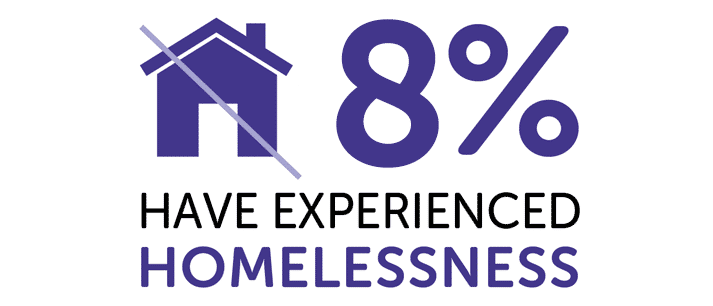
This year, 8% of respondents said that they had experienced homelessness as a student – a slight increase on 2025 and 2024's results (both 7%).
While it's too early to say for sure that student homelessness is getting worse, our findings clearly show that at the very least, the situation isn't improving.
Whether it's rough sleeping, sofa surfing, squatting or any other form of homelessness, none of these are adequate forms of accommodation. Again, the affordability and availability of student housing comes into question.
This is what respondents told us about their experiences of homelessness at university:
- [There was a] backlog of students applying to uni [and there was] no accommodation left, so [I] had to sofa surf at friends', or stay in [the] library. Also, while [I had] accommodation, [I had] to stay in [the] library either because [my room was] damaged, or it was better than the room.
- [I] couldn't find accommodation, so I had to sleep in hostels for a couple [of] months before moving back home.
- [I] got kicked out of [my] home [and] had to sleep in my car. [I] went to McDonald's to charge my phone and eat small amounts, and washed my clothes at friends' houses.
- I had nowhere to live at the start of the year because I couldn't afford a 12-month contract. I was trying to keep [spending] to a minimum, so for the first two weeks of uni I was sleeping on mates' sofas and in my car.
- I was evicted from [my] house because I couldn't meet up the deadline to pay my rent, so I had to sleep in a friend's house. But she had other roommates [and] there [was] no mattress for me to use, so I had to sleep on the floor.
- [We discovered our] landlord didn't have [a] licence to rent out the property after we had already agreed a move-in date and handed in [our] notice to [our] old rental. [It] took over a month to finally move in, and [in the meantime I] had to live in hotels and [at my] parents' house.
How much does student accommodation cost?
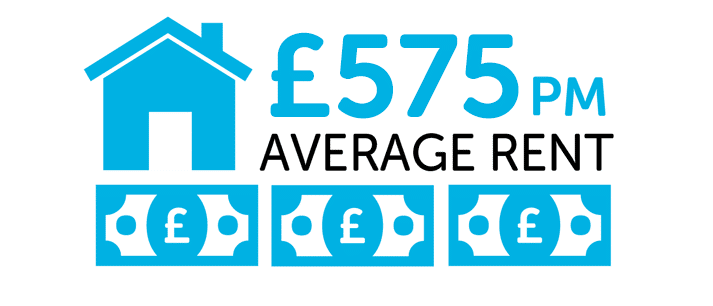
Among the students in our survey who pay rent, the average cost was £575 per month. Compared to 2025, this represents a 2.1% increase – significantly below inflation for the same period (CPI was roughly 3.5% while the survey was open).
However, data from Zoopla found that UK rents rose by 2.2% between October 2024 – October 2025, suggesting that the 2.1% price hike experienced by students over a similar timespan is representative of the wider market.
| Survey year | Average rent paid | Percentage increase in rent | CPI inflation (December prior to survey publication) | English Maintenance Loan increase (compared to previous academic year) |
|---|---|---|---|---|
| 2023 | £535 | - | - | - |
| 2024 | £550 | 2.8% | 4% | 2.8% |
| 2025 | £563 | 2.4% | 2.5% | 2.5% |
| 2026 | £575 | 2.1% | 3.4% | 3.1% |
For several years now, although our survey has found that students are paying more and more rent, the percentage rise has been consistently less than, or equal to, both CPI inflation and increases to the Maintenance Loan in England. In other words, rents are rising more slowly than other costs, and funding is increasing more quickly than rent.
Over three-quarters (77%) of respondents said they think rent should be tied to Maintenance Loans, and it seems accommodation providers are listening.
But, of course, rent is far from the only expense facing students. As our National Student Money Survey has uncovered, spiralling costs in other areas – particularly food – coupled with massively below-inflation increases to the Maintenance Loan in previous years, mean that even modest rent hikes will stretch budgets.
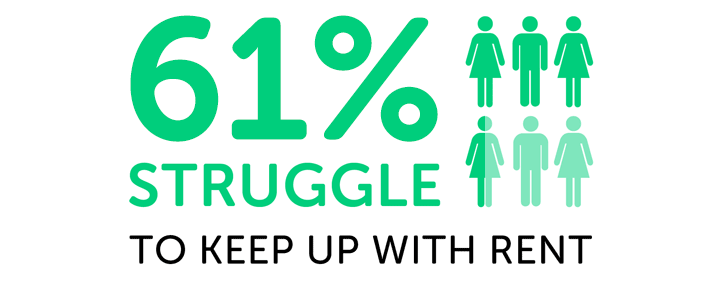
With that in mind, it should come as no surprise that 61% of respondents told us they struggle with rent at least some of the time (up from 59% last year), including 17% who describe it as a 'constant' battle.
Even if rents were frozen, the real-terms Maintenance Loan cuts have become baked into the system. Students are now significantly worse off than they were pre-pandemic, when loans were already scarcely enough to cover living costs.
The government's announcement that Maintenance Loans will increase annually with forecast inflation will do little to help. Indeed, it's the same policy that was already in place and caused this very issue.
The only solution is for the government to implement a substantial increase in maintenance funding to bridge the real-terms shortfall that has emerged.
Average student rent across the UK
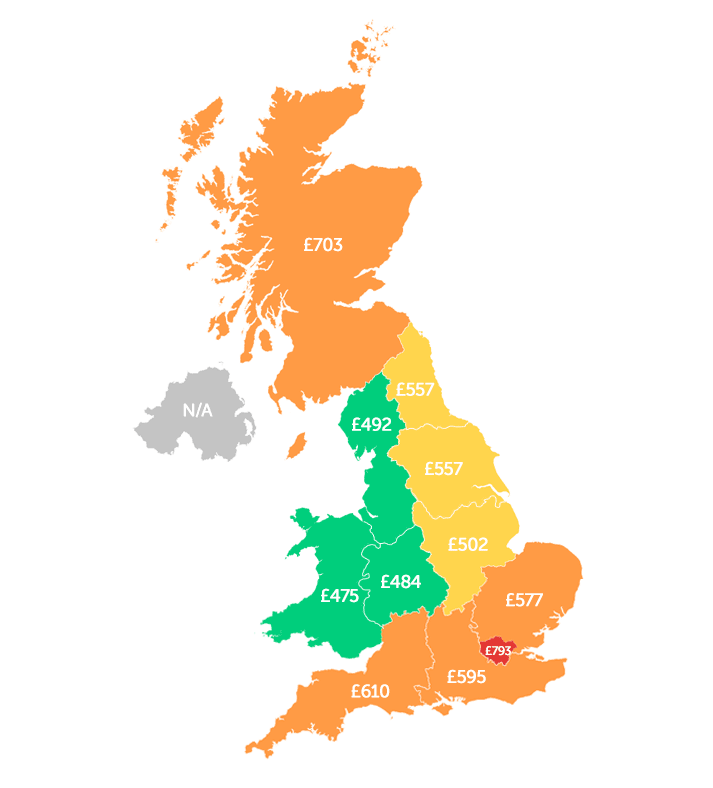
Surveyed students in London faced the highest rents of all respondents, paying an average of £793 per month.
Scotland is once again the second most expensive region, with respondents there reporting an average rent of £703 per month.
By contrast, those in Wales paid the least rent (£475 per month), with surveyed students in the West Midlands (£484 per month) and North West of England (£492 per month) paying marginally more.
Unfortunately, we didn't receive enough responses in Northern Ireland to provide a reliable average rent for the region.
Student rent by accommodation type
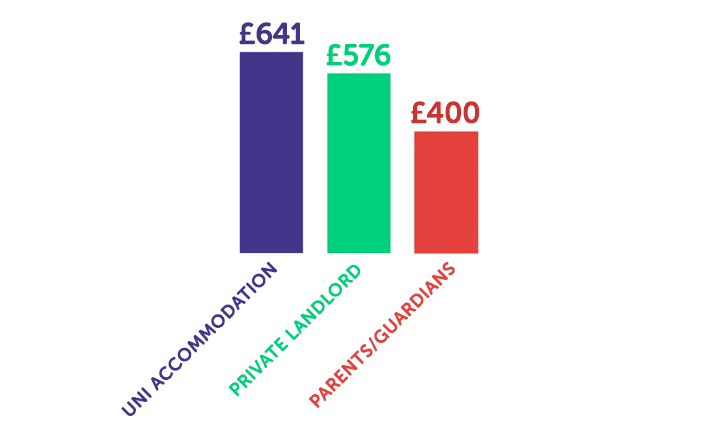
Due to a number of significant outliers, we were unable to calculate the average cost of rent in private halls.
When broken down by three of the most common types of accommodation, surveyed students living with their parents or guardians pay the least (£400 per month).
However, this marks a significant increase on last year's figure (£345 per month), echoing later findings in this survey which suggest parents are having to scale back the financial assistance they give their children at university.
What is included in student rent?
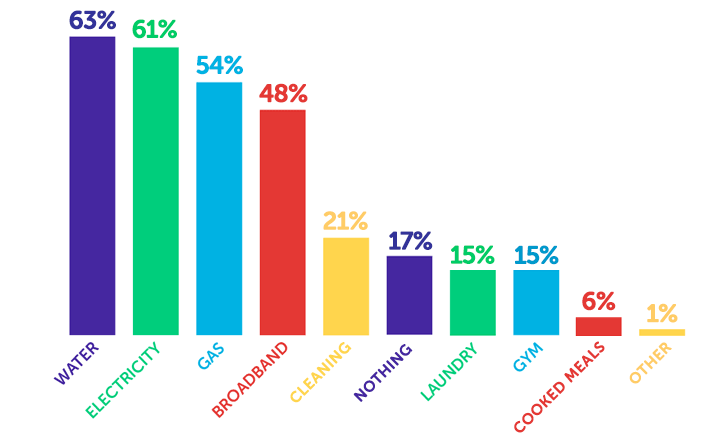
Depending on where a student lives and how much they pay, they may get various amenities included in the cost of their accommodation.
In fact, as many as four in five (80%) respondents said their rent covered the cost of at least one extra service. Most commonly, this included water (63%), electricity (61%) or gas (54%), with just under half (48%) saying broadband was bundled in.
How much are student rental deposits?

Of the respondents who paid a deposit, the average amount was £433.
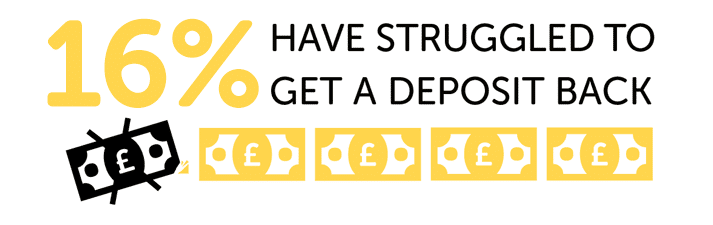
However, of that same group, 16% said they had struggled to get their deposit back at some point while at university.
Here's what some students told us about the issues they've faced reclaiming their deposits, and the reasons why money was withheld:
- 'Cleaning costs', because dust accumulated during the [period after] we moved out.
- They said there were water spots on the wall, but they were there when I moved in.
- Things we argued were wear and tear. [The landlord] also tried to charge us for the painter he got to paint over the damp when the roof leaked into my room.
- Mould that was not caused by us.
- Part of my deposit was withheld due to cleaning charges and minor wear and tear, even though the room was left in good condition. Communication from the landlord/agency was unclear and slow, which made resolving it difficult.
- The agent accused us of not leaving [the] accommodation to the acceptable standard. We [responded] with a question looking for the inventory. There was no inventory, so we got our money back.
- [The landlord] told us to our faces on multiple occasions that we'd have no problem getting the deposit back, and then tried to withhold £250 for 'cleaning fees' even though we'd left the house cleaner than when we moved in. Thankfully the agency we were letting through decided to return the full deposit to us anyway.
As ever, many of the written responses detail a difference of opinion over who was responsible for damage, or if something predated the tenancy.
Often, simple steps such as requesting an inventory or taking photos upon moving in and out can be enough to avoid these issues.
Otherwise, it's important that students know that they can dispute any deductions from their deposit.
A key point to remember is that the burden of proof usually lies with the landlord. So, for example, if they failed to provide an inventory at the start of the tenancy, it will be harder for them to prove that any damage wasn't already there. In such a case, the deposit scheme may rule in favour of the tenant.
How much are student energy bills?

Of the students in our survey who pay bills separately, the average spend on energy was £83 per month. This is slightly less than in 2025 (£88), but represents consistency over a four-year period, where the average spend has always been between £83 – £88.
Despite the small drop in cost, there has been an increase in the proportion of respondents who say they're struggling to keep up with the cost of energy bills.
This year, that figure stands at 58%, up from 56% in 2025. Crucially, 19% described it as a 'constant struggle', compared to just 15% last year.
Interestingly, however, the proportion of students saying they've taken one or more measures to reduce their energy usage has declined for the third consecutive year – albeit still very high at 85%.
| Ways to use less energy | How many respondents did this in 2025*? | How many respondents did this in 2026*? | Difference (percentage points) |
|---|---|---|---|
| Not put the heating on | 59% | 61% | + 2 |
| Stayed in bed longer than usual to stay warm | 55% | 50% | - 5 |
| Asked housemates to use less electricity/gas | 51% | 44% | - 7 |
| Had shorter/fewer showers | 45% | 43% | - 2 |
| Spent longer at uni to avoid using electricity/gas at home | 44% | 41% | - 3 |
| Not cooked as often | 37% | 33% | - 4 |
| Used an electric blanket | 21% | 18% | - 3 |
| Asked landlord to improve insulation | 11% | 11% | 0 |
*This data only includes those who pay bills separately.
In fact, looking at the specific ways in which we ask students if they've reduced their energy usage, only one was more popular than in 2025 (not putting the heating on). The proportion of respondents using every other method was either lower or the same as last year.
Nonetheless, the cost of energy remains a huge challenge for many students, as detailed by these respondents' comments:
- [I] charge everything and a power bank at the library.
- I have resorted to 10-minute showers twice a week to reduce my energy bill cost, and I stay in bed longer to remain warmer so I don't have to rely on heating.
- I've spent a lot of time and energy fixing up my place to make it liveable. I've bought supplies to fill gaps and block cavities that were letting in freezing cold air (and pests!) from the basement. I've pinned blankets in front of the window, installed radiator foil, tinkered with the boiler and bought a bunch of winter clothes and blankets to ensure that I don't blow all of my maintenance loan on heating costs.
- Sometimes I sleep all day because if I'm asleep I cannot get hungry or cold, or want to eat or put on the heating. The cold causes me pain due to my disabilities, and sleep stops a lot of pain.
- [I have] spent more time in the library so I don't have to use electricity at home. [I use] candles instead of lights at home. [I have] quick showers and switch off [the] shower when putting conditioner in and using shower gel.
- Due to the cost of gas and electricity I often stay in uni longer than I should, and also, to avoid cooking that will require me [to use] gas, I will just buy snacks. When [I] am cold I will use blankets to cover myself instead of using the heater.
How rental costs impact students' health and studies
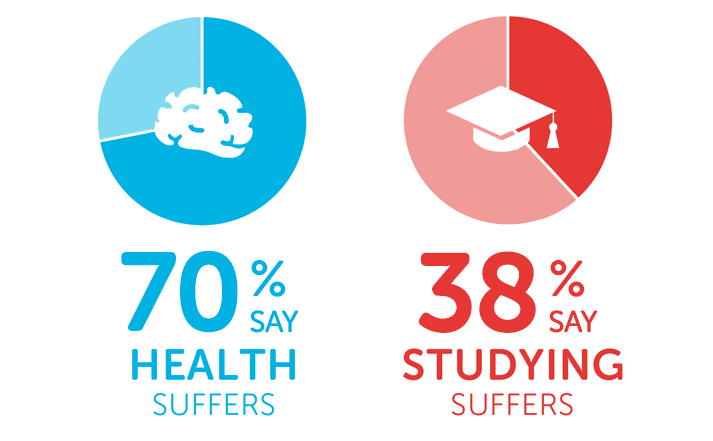
When combining the respondents who said that either their mental or physical health suffered from rental costs, the overall proportion impacted was 70%. While this is only a small rise compared to 2025 (72%), the long-term trend is one of notable increase:
| Survey year | % who said their overall health suffers somewhat | % who said their overall health suffers greatly | Total |
|---|---|---|---|
| 2022 | 44% | 10% | 60% |
| 2023 | 45% | 15% | 62% |
| 2024 | 53% | 19% | 72% |
| 2025 | 49% | 19% | 68% |
| 2026 | 52% | 18% | 70% |
Over the past five years, there has been a marked increase in the proportion of respondents saying their health suffers either 'somewhat' or 'greatly'. This has led to a 10 percentage-point rise in the overall figure, correlating closely with the period when real-terms Maintenance Loans cuts have become embedded in the system.
And health isn't the only casualty of life as a student renter. Of the respondents who had experienced at least one problem with their accommodation, 38% said their studies had suffered as a result.
Students considering dropping out of university
The cumulative strain that renting can place on a student's finances, health, studies and more can often cause them to consider leaving university.
| Have students considered dropping out? | Rent | Bills |
|---|---|---|
| Yes – thought about it | 36% | 26% |
| Yes – have dropped out | 2% | 2% |
| No | 62% | 73% |
Although the proportion who said they've dropped out of university due to the cost of bills has decreased by one percentage point since 2025 (down from 3% to 2%), there has been a larger increase in those saying they've considered it (26%, up from 23%).
Meanwhile, the proportions saying they've either gone through with, considered, or not thought about dropping out due to the cost of rent have all remained exactly the same.
Here are some of the troubling stories that students shared with us about keeping up with rent at university:
- Currently on attempt number two at studying at uni. The first time was in London and rent costs were a factor for my dropping out the first time.
- Dropping out isn't an option for me since I am estranged and would be homeless without student accommodation.
- I can't focus on my [university] work when I have to find a way to make money all day.
- I don't have much money left after paying rent, and I have multiple chronic illnesses which make it hard for me to find long-term work. Uni takes up the majority of my time and effort, making me think I would be able to live better if I dropped out and instead focused on working.
- I feel like I may run out of money before I graduate and have nothing to show for all the stress of studying and paying bills. I work 20 hours per week, but it's not enough to live without stress.
- I had to drop out of my previous uni in London due to being homeless. Now I'm in my second year and I am struggling because the costs have all risen, but bursaries/loans [...] aren't rising to meet this.
- When you're so stressed at uni, with a job and still not making ends meet, it's so frustrating and makes you wonder why you're bothering when degrees don't even get you much nowadays.
- My Maintenance Loan just about covers rent during term and holidays, leaving little money left for food, transport etc. I live in London and am struggling to find a job. I am separated from my parents so they cant support me much. My room has poor/no heating and I have Raynaud's, so it is really tough in winter.
- Rent puts a huge strain on [my] mental and physical health, sometimes I wonder if it's worth going into debt for.
How do students pay for their rent?
As has become well established, today's students are facing enormous financial challenges. This is in large part due to their Maintenance Loans falling short of inflation.
With their Student Finance funding failing to cover costs, many are having to make ends meet through other means – including borrowing.
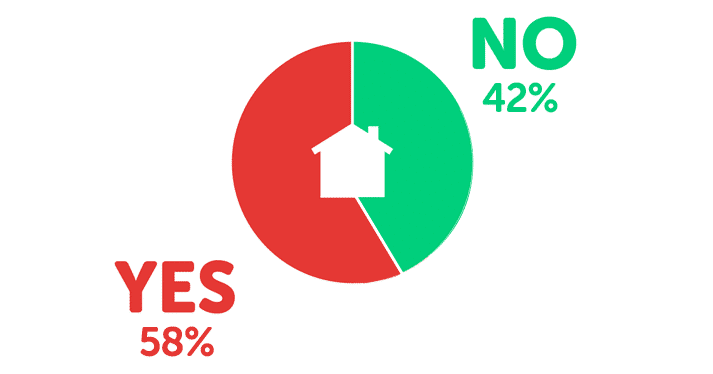
This year, 58% of surveyed students said they'd borrowed money from at least one source to pay for their rent – a sharp increase on 2025 (51%).
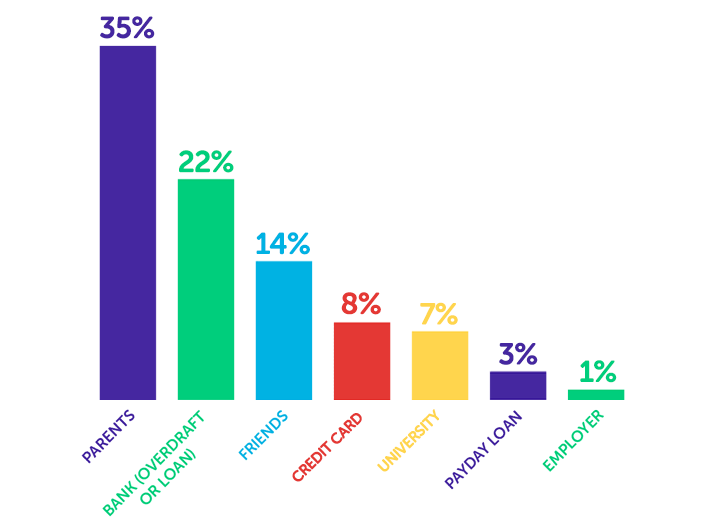
The most common source of borrowed cash was parents, with 35% of respondents turning to them (up from 28% in 2025).
There has also been a slight increase in the proportion of respondents using a bank loan or overdraft (22%, up from 21%) or asking friends (14%, up from 12%) for money to pay rent.
Parental contributions to student rent
*This stat does not differentiate between money parents have lent and money they have gifted.
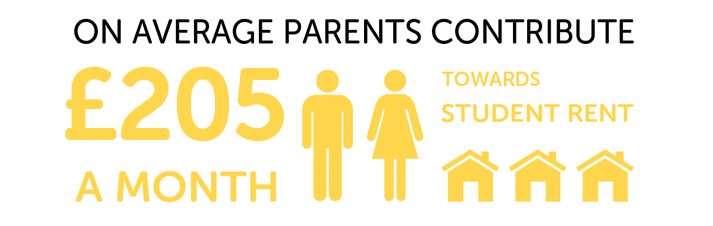
Despite a higher proportion of respondents borrowing money from their parents, the average amount they receive (either gifted or lent) has declined to £205 per month (compared to £224 in 2025).
This echoes the findings of our most recent National Student Money Survey, which also uncovered a drop in parental contributions.
As we suggested in that report, there appears to be an obvious cause for this. The ongoing cost of living crisis will naturally squeeze household finances, placing greater scrutiny on the contribution parents make to their children.
Students in rent arrears
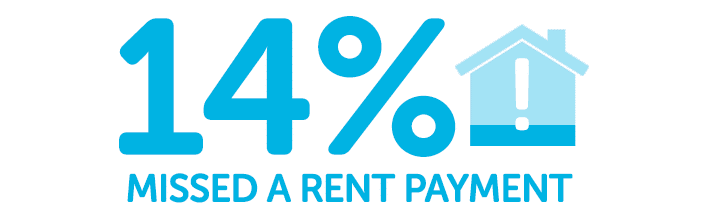
Around one in seven respondents (14%) said they'd missed a rent payment at some point while at university. While this is only slightly more than in 2025 (13%), the proportion who were in rent arrears at the time of the survey has increased more substantially, from 7% to 10%.
Among that 10%, the average amount owed was £621.
Meanwhile, 3% of surveyed students said they had previously been evicted for not paying rent. This figure has been steady since 2024, but with the Renters' Rights Act coming into force in May 2026, we anticipate this stat could be lower in future.
Under the new legislation, renters must have accrued at least three months' worth of rent arrears before they can be evicted. This has increased from two months, and should provide extra breathing room for struggling tenants.
Here's a selection of quotes from students who have been unable to pay rent:
- [I] ended up in a homeless hostel.
- [I] had to get [an] emergency loan and apply for hardship payments from the uni.
- I didn't receive my student loan until after my rent was due so I had to ask for an extension.
- I had a family emergency. My dad suffered a stroke and we were in a bad shape financially at that time. Much of my savings and cashing [in] my possessions were then used to cover medical costs. Thankfully, I have a wonderful relationship with my landlord so it wasn't hard to pay up the missed months.
- I had to pay a late fee.
- I was not going to be able to pay the full rent amount for my first term since I was suddenly estranged. I notified the financial team at my uni of this and the deadline to pay my rent was extended.
What issues do student renters face?
Whether it's with their housemates or the property, student renters often face issues in their homes.
Biggest problems with student houses
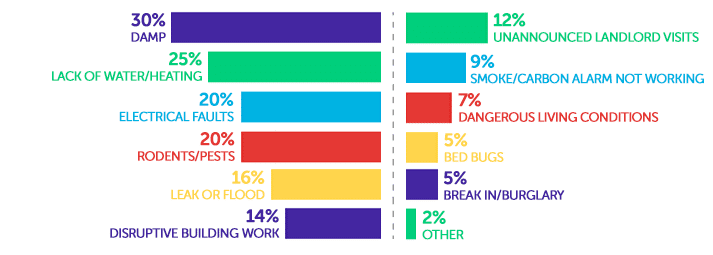
Just shy of two-thirds of surveyed students (65%) said they'd had at least one problem with their home. 43% of respondents said they'd experienced at least two problems, while 9% said they'd faced five or more issues.
The overall proportion of respondents who have faced problems is lower than in 2025 (69%). And across most issues, the proportion of respondents saying that they've had to contend with them has dropped.
Damp (30%) remains the most common problem faced by those in the survey, followed by a lack of water or heating (25%), electrical faults (20%) and rodents or pests (20%).
Although the Renters' Rights Act becomes law in May 2026, the Decent Homes Standard won't be fully implemented for private rentals until 2035.
This legislation will introduce a minimum quality requirement for properties, and aims to ensure rented homes are free of many of the issues students currently face. The delayed enforcement leaves today's renters with an ongoing battle to secure acceptable living conditions.
How long does it take for issues to be sorted?
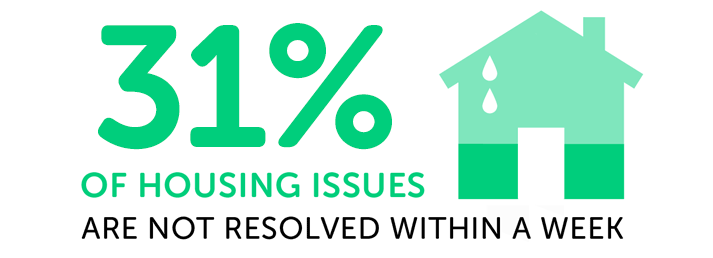
Among respondents who had experienced at least one problem with their property, 31% said the issue wasn't resolved within a week, with 5% saying it was never sorted at all.
However, 52% said their issues were resolved within seven days, and 17% told us they were sorted within 24 hours.
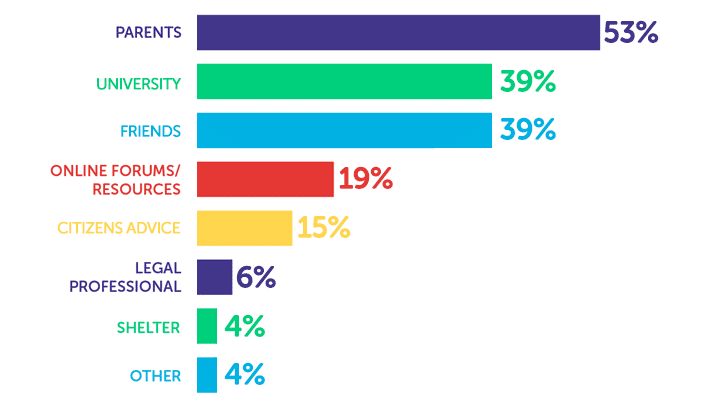
With students often being first-time renters, it's natural that many will seek help along the way.
Of those who have turned to a third party, parents (53%) were once again the most common source of advice, with university accommodation services (39%) and friends (39%) the joint-second most popular avenues.
We received dozens of additional comments from respondents describing difficulties with their landlord or property management. This is just a small selection:
- There wasn't any WiFi connection, so I contacted the halls office but they said they can't fix it and told me to contact the WiFi provider. It took them five weeks to actually come and fix it! Both parties told me different things about how I can resolve this throughout the five weeks, and I ended up having to spend more than £60 on data so I could hand in my uni work on time.
- [We had a] constant leak [which we] reported several times but were told that it wasn't high enough priority to do anything, even though it was damaging [the] property. [It was] leaking out [into the] smoke alarm, fuse box and ceiling lights, tripping the electrics [and] causing extreme stress.
- [We] had a huge leak in our kitchen and two bedrooms. [It] was reported three months ago and is still not fixed.
- Last year my bedroom window didn't open for almost the entire year, despite constant communication and complaints to my landlord. This severely affected my health and I was not compensated at all. My bed was unusable for the first week as the frame was broken and dangerously unstable.
- My window lock has been broken since I moved in. I reported it and yet they've done nothing but put on the system [that] it has been resolved. I live at the front of the building so it's facing the other buildings and people walk past drunk at night, [making] me feel unsafe.
- [We had] no hot water, [it] took them six and a half – nearly seven – weeks to fix.
- Our kitchen's electric stove took a full month to repair – and required emailing multiple times, only for the maintenance team to pass the buck onto someone else.
- Small issues reported will be fixed within a matter of days. However, bigger issues take longer to be solved e.g. a broken kettle will be replaced within days, but a broken oven or fridge could take months or longer.
- The whole flat had no hot water for over three weeks. We couldn't wash up properly, leaving a mess of moulding dishes on the kitchen side. We couldn't shower, and after a week had to go to the halls office to complain and use a different flat for showers.
- We had one issue with damp which we regularly contacted the landlord about. They said they would resolve it and never did, and it ended up coming out of our deposit.
Students and the Renters' Rights Act
After many years of discussion, the Renters' Rights Act will finally become law on 1st May 2026. These are some of the changes it will make*:
- A ban on 'no fault' evictions
- An end to fixed-term tenancies; all tenancies will become rolling
- A ban on bidding wars for rental properties
- Tenants will be able to terminate their contract by serving at least two months' notice
- Landlords will only be able to increase the rent once a year
- Landlords will only be able to ask for a maximum of one month's rent in advance.
*Some exceptions have been made in the student sector, including for landlords who wish to let their property to a new set of students in the next academic year, and for students living in university halls. See here for more details.
Despite the significant reforms it will introduce, just 45% of surveyed students were aware of the Renters' Rights Act, and even fewer (18%) said they understood what it would change.
Of those who had heard of the legislation, 51% felt it was either a 'positive' or 'very positive' move. A small minority (5%) thought it was either 'negative' or 'very negative', with the remaining 45% feeling it was 'neutral'.
Biggest problems with student housemates
Beyond the issues students face with their properties, many also report gripes with their housemates.
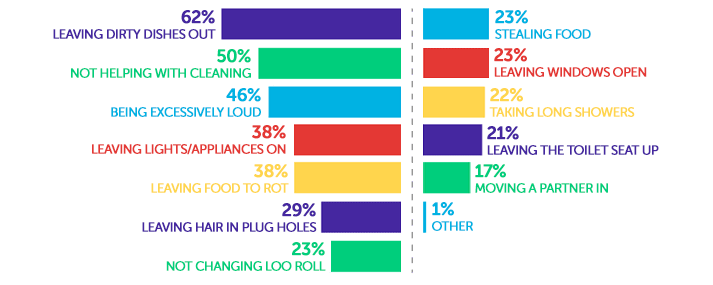
Of the respondents who live with at least one other person, 82% said they'd had one or more issues with them.
The two most common complaints concern cleanliness, with 62% frustrated with other people leaving dirty dishes out, and 50% saying their housemates don't help with cleaning. Other similar grievances include food being left to rot (38%) and housemates leaving hair in the plughole (29%).
Just under half (46%) complained that their housemates were excessively loud.
Is student housing worth the money?
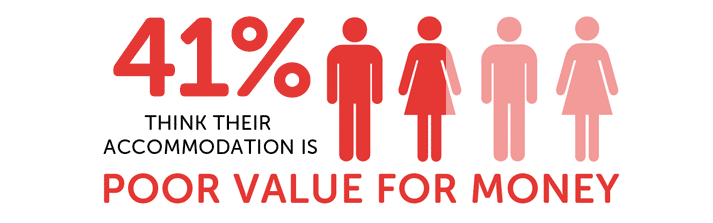
In total, 41% of surveyed students felt their accommodation didn't represent value for money.
| Accommodation type | How many think student accommodation is good value for money? |
|---|---|
| Private landlord | 49% |
| University halls | 58% |
| With parents/guardians | 72% |
| Private halls | 61% |
When looking specifically at the four most common types of student accommodation, there is a clear split in the levels of satisfaction.
The most satisfied by far were those living with their parents (72%). By contrast, those privately renting from a landlord were the least likely to say their accommodation represented value for money (49%).
This is what students told us they love and hate about their accommodation:
- It's exploitation to charge extortionate amounts to live in a cupboard. I'm paying £215 a week because of my disability and it isn't even comfortable.
- It's mouldy, it took a year to fix my friend's room, the landlord ignores us and walks into rooms unannounced – and we're paying so much.
- Living here lets me meet people from all over the world, which has been one of the best parts of university.
- It's shockingly cold and the EPC rating is so bad, we're scared to put the heating on.
- I love living alone – it's quiet, peaceful, and really helps with my autism and anxiety.
- [I pay] £250 a week for a basic en-suite that's no nicer than anywhere else, and my flatmates are awful.
- Bills are included, it's good value for money, and staff actually respond when something goes wrong.
- It's cold and damp so there's black mould everywhere. We also have mice and I regularly have to check my bed for droppings.
- I love the sense of community and the events they run – it made a new city feel like home.
- Too expensive for a load of rubbish. We don't even have a hoover and my room is so small I have to climb on my bed to shut the door.
Students' house-buying prospects
Getting onto the housing ladder has become notoriously difficult for young people – something that our survey respondents seem all too aware of.
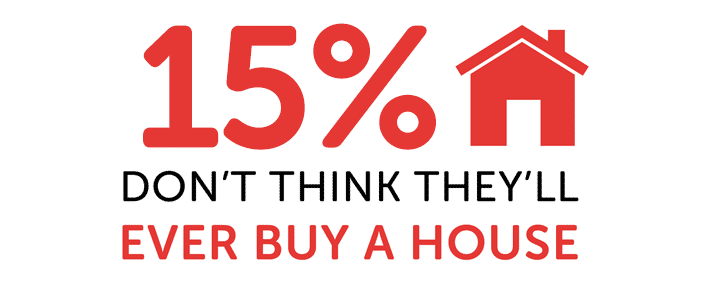
Just over one in seven (15%) of surveyed students are resigned to never owning a house, with almost a quarter (24%) believing they'll be 35 or older before they become a homeowner.
A fifth of respondents (20%) think they'll buy their first home at age 30, while 11% believe they'll do so when they're 25.
Additional expert quotes
In response to the survey, Vivienne Stern MBE, Chief Executive of Universities UK (UUK), said:
The rising cost of living remains a significant issue for students across the country. As the survey highlights, housing issues can have a significant impact on students' university experience, particularly students from disadvantaged backgrounds who stand to gain the most from going to university.
While universities are going the extra mile to support those who need it, the government should review maintenance loan eligibility thresholds and parental contribution to reduce the financial burden on students and their families. No one should be put off pursuing the lifetime benefits of higher education, like better job prospects and higher earnings, because their family's financial situation makes it harder for them to access housing at university.
As the Renters' Rights Act comes into force we want to work closely with government to monitor the availability of housing and avoid any further reduction in supply of accommodation.
Student housing resources
These guides include info or advice about many of the topics covered in this report:
- National Student Money Survey 2025
- Student rent calculator
- How to get help with energy bills
- Cost of living crisis: 20 ways to cope
- Parental contributions calculator
- How to save money on rent.
About the National Student Accommodation Survey 2026
If you'd like to know more about the survey or receive expert comments, please get in touch.
You're welcome to reference or re-use data from the survey with credit and a link back to the site: "Source: The National Student Accommodation Survey 2026 / www.savethestudent.org".
Stats were calculated based on 1,149 responses, cleaned to remove non-students and clearly false entries.
The survey was open for responses from 11th November 2025 – 9th January 2026.




![What do students spend money on? [stats]](https://www.savethestudent.org/uploads/what_students_spend_money_on2-252x160.png)
![What do students spend money on? [stats]](https://www.savethestudent.org/uploads/what_students_spend_money_on2-100x100.png)